
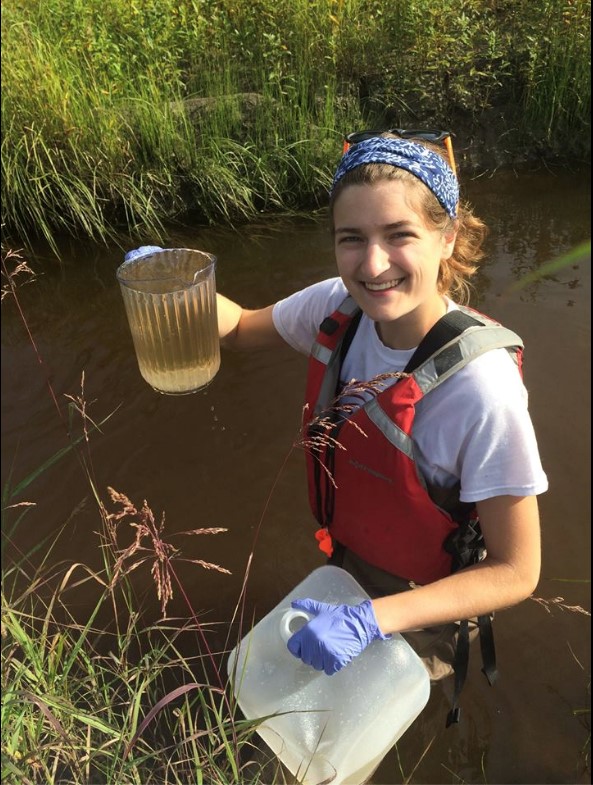
Permafrost holds 750-950 Gt of organic carbon, and thus thawing permafrost could potentially release 7 times more organic carbon than currently present in permafrost-free soils and waters. Portions of interior Alaska are underlain by organic rich permafrost from the late Pleistocene era. These locations have potentially significant ramifications on the global carbon cycle due to the large amount of sequestered carbon that will mobilize upon thaw. I will characterize natural organic matter (NOM) chemical composition from permafrost and overlying waters in discontinuous and continuous permafrost regions to determine historic and modern influences on the fate and transformation of permafrost organic carbon. Chemical characterization will occur through the use of analytical instrumentation to observe NOM on a molecular scale. Also, a solid phase extraction method will be utilized to obtain a shelf stable solid material, which will then be used in photolytic experiments to determine the reactivity and chemical composition of NOM samples. I hypothesize that permafrost NOM will have different reactivity potential than modern surface water carbon content, thus influencing carbon cycling within the Arctic. My research directly gains scientific knowledge of the earth’s impact on climate through human induced and natural permafrost thaw, which releases greenhouse gases into the atmosphere through degradation of the carbon content. Also, a better understanding of permafrost carbon chemical composition is essential for understanding the stepping-stones to methane and carbon dioxide production through permafrost thaw and thus assisting researchers in the NASA ABoVE program studying methane production in the Arctic.
Profile
Name: Kristin Gagne, Graduate Student
Institution: University of Alaska Fairbanks
Mentor: Jennifer Guerard, jguerard@alaska.edu
Award: Research Grant
Funding Period: 2017