
SPACE TECHNOLOGY
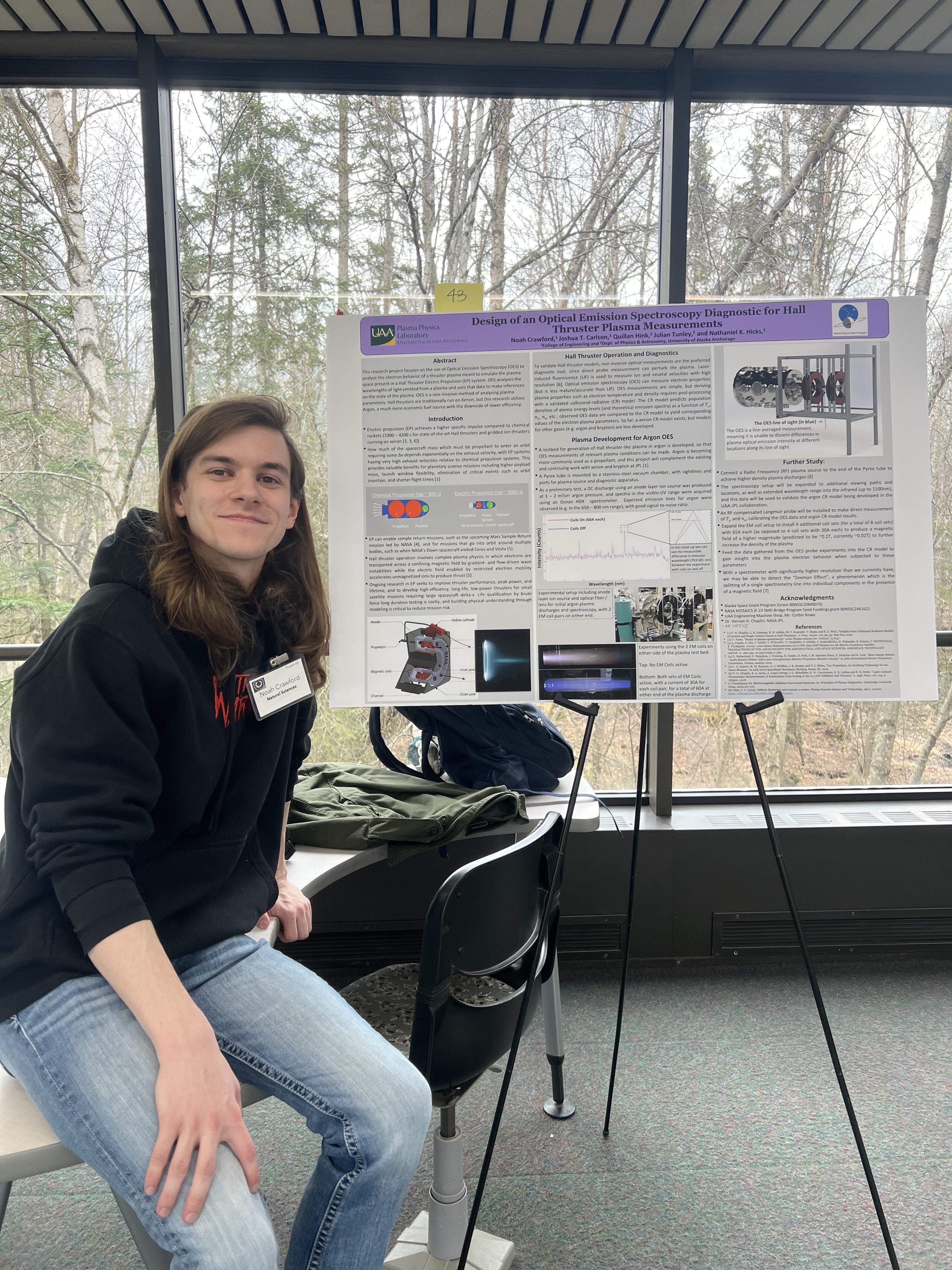
Plasma can be found in abundance throughout the observable universe. Its applications are numerous, but one promising application is creating the plasma environment that is used for electric propulsion (EP) systems, including the Ion and Hall thrusters that are currently in use across many spacecraft. Despite the promise of EP systems, however, the fundamental understanding of EP thrusters has fallen behind the technological advances in the field. Research into measuring and analyzing the electron behavior within EP thruster plasmas is relevant to one of NASA’s Physical Sciences Program’s core objectives, specifically: “Provide mechanistic understanding of processes underlying space exploration technologies such as power generation and storage, space propulsion…”. The research proposed here centers on gathering spectroscopic data connected with the properties of the electrons within the plasma volume, particularly the electron density and the electron temperature, which can be processed using a physics-based mathematical framework called a Collisional-Radiative (CR) model. The CR model development in MATLAB has been initiated as part of my internship at NASA Jet Propulsion Laboratory (JPL) this past summer. These data and analyses will help provide understanding of Ion and, in particular, Hall thrusters, along with validation of the CR model, allowing future work to understand, predict, and optimize electron behavior for new or improved EP system designs.
Profile
Name: Noah Crawford, Undergraduate Student
Institution: University of Alaska Anchorage
Major: Mechanical Engineering
Mentor: Nathaniel Hicks, nkhicks@alaska.edu
Award: Apprenticeship
Funding Period: 2025 to 2026
Attachment: Crawford-UAA_Poster.pdf