
SCIENCE
The magnetosphere is the region around the Earth dominated by the geomagnetic field and permeated by a dense cold plasma (electrons and ions) and Van Allen radiation belts containing energetic electrons and protons. The goal of the proposed research is to develop and implement a new remote sensing method to obtain magnetospheric electron and ion density using observations of lighting energy received on a satellite. Electron and ion densities play important roles in magnetospheric processes such as wave-particle interactions in the equatorial region and ion-neutral dynamics in the ionosphere, and are important for calculating space weather effects such as particle precipitation, GPS scintillations, and satellite drag. Lighting energy injected from the ground reaches the satellite by multiple paths with delays that vary with frequency (see Figure 1). The energy reaching the satellite by each of the paths are called whistler traces (Figures 2 and 3) [Helliwell, 1965]. Following a method by Sonwalkar et al. [2011a, b], the proposed research involves iteratively simulating lighting energy propagation using an assumed magnetospheric electron and ion density model to obtain whistler traces that match whistler observations on satellites to determine the electron and ion densities. The research proposed here is relevant to the following Heliophysics Decadal survey goal: determine the dynamics and coupling of Earth’s magnetosphere, ionosphere, and atmosphere and their response to solar and terrestrial inputs, and to NASA’s heliophysics strategic objective: to understand the Sun and its interactions with the Earth and the solar system, including space weather. The relevance of the proposed research to this particular objective of NASA is in its focus upon measurements of magnetospheric electron and ion densities that play an important role in the physics of wave particle interactions and the coupling of thermosphere-ionosphere-magnetosphere system. The proposed work complements the objectives of Van Allen Probes mission and should enhance the research carried out under that mission. The remote sensing method developed here will be applicable to past (e.g. DE 1, POLAR), current (e.g. Van Allen Probe), and future magnetospheric satellites (e.g. DSX) carrying wave instruments.
Profile
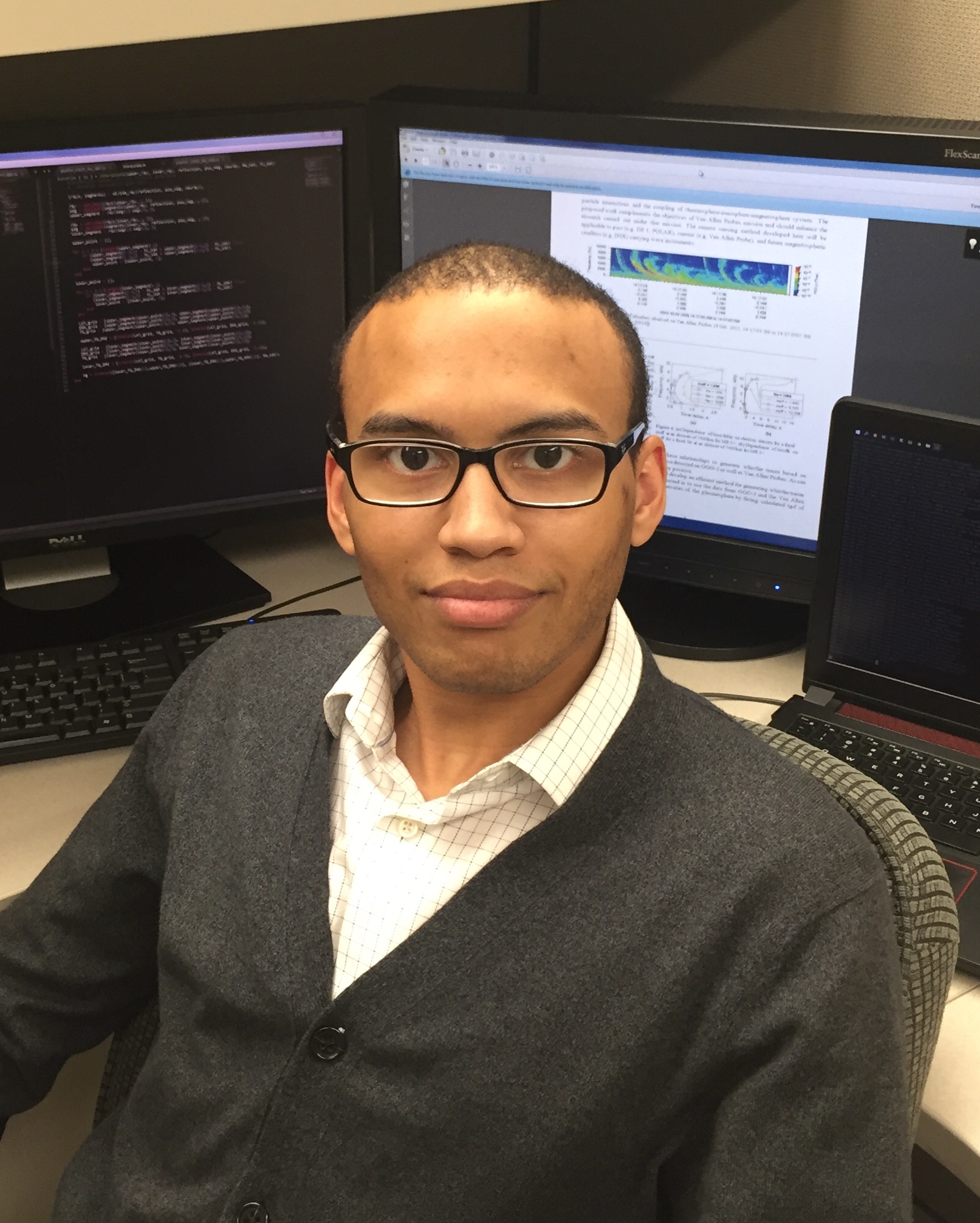
Name: Jacob Butler, Undergraduate Student
Institution: University of Alaska Fairbanks
Major: Computer Science
Mentor: Vikas Sonwalkar, vssonwalkar@alaska.edu
Award: Apprenticeship
Funding Period: 2017 to 2018